
A Note from the Curator
To understand Jung is to realize that wisdom is not just found in history books—it is carried within our very DNA. Because it is easy to lose sight of these truths in a fast-paced world, I have curated the symbols discussed in this article into physical Visual Anchors. These heritage prints are designed to act as a recurring point of contact between your daily life and your ancestral roots. You can find the specific pieces featured in this article within the Wisdom & Identity Gallery of the Heritage Archive
Carl Jung believed we are never truly individuals in isolation — we are living expressions of a lineage that stretches back centuries. Today, a growing number of people are discovering that Jungian symbols, embodied in heritage artifacts, offer a powerful and tangible way to connect with that inheritance.
What Are Jungian Symbols, and Why Do They Still Matter?
Carl Jung, the Swiss psychiatrist who founded analytical psychology, devoted much of his life’s work to a radical idea: that beneath our personal memories and experiences lies a deeper layer of the human psyche he called the collective unconscious. This shared dimension of the mind, he argued, is populated by universal patterns he named archetypes — and those archetypes express themselves through symbols.
Jungian symbols are not mere decorations or historical curiosities. They are what Jung called “living things” — images charged with psychic energy that have been refined across centuries of human experience. A tree. A circle. A set of interlocking geometric forms. A craftsman’s mark passed down through a fraternal lodge. These images recur across cultures precisely because they speak to something fundamental in the human psyche, something we all carry regardless of when or where we were born.
Jung put it plainly: “The collective unconscious contains the whole spiritual heritage of mankind’s evolution, born anew in the brain structure of every individual.”
In practical terms, this means that when you encounter a symbol your ancestors used — a Celtic knotwork, a Nordic rune, a Shaker Tree of Life, or the emblems of a century-old fraternal order — you are not just looking at the past. You are, in a very real psychological sense, looking at yourself.
The Ancestral Dimension: Why Our Roots Shape Who We Are
Before exploring how Jungian symbols function as visual anchors, it helps to understand the deeper premise at work: that ancestral influence is not merely sentimental. According to Jung, it is structural.
Carrying What Our Ancestors Couldn’t Resolve
One of Jung’s most resonant observations was this: “The greatest burden a child must bear is the unlived life of its parents.” This idea extends beyond any single generation. Patterns of behavior, emotional responses, even unconscious beliefs can move through family lines like invisible currents, shaping choices long after the original circumstances have passed.
Jung cautioned that “until you make the unconscious conscious, it will direct your life and you will call it fate.” The invitation here is not to be overwhelmed by ancestry, but to become curious about it — to ask what patterns might be running quietly beneath the surface of your own story.
We Are an Immense Age
“We are not of today or yesterday; we are of an immense age,” Jung wrote. This perspective reframes identity entirely. Who we are is not simply the product of our childhood, our education, or our choices. It is the accumulation of countless lives, struggles, and hard-won wisdoms. Jung described the individual as “an expression of the collective unconscious, which connects him with all mankind and with all the ancestors.”
This is not mysticism — it is a map of the psyche. And like any map, it is most useful when made visible.
What Is a Visual Anchor in Jungian Psychology?
A visual anchor is a physical symbol placed intentionally in your environment to serve as a daily reminder of something your conscious mind might otherwise forget. In Jungian terms, it is a way of keeping the unconscious in conversation with the conscious self — a practice Jung considered essential to psychological wholeness, or what he called individuation.
Jung wrote that “man’s task is to become conscious of the contents that press upward from the unconscious.” Visual anchors serve exactly that function. They create a recurring point of contact between your outer life and the deeper currents beneath it.
The key word is intentional. A mass-produced print chosen for its color palette does not carry the same weight as a heritage artifact chosen because it resonates with your lineage, your values, or your ongoing journey of self-understanding. The difference lies in meaning — and meaning, for Jung, was the currency of psychological health.
Heritage Artifacts as Jungian Symbols: A Living Practice
This is where ancient psychology and present-day practice meet. Heritage artifacts — historical prints, folk art, fraternal emblems, and cultural symbols drawn from specific traditions — function as ready-made Jungian symbols because they have already been charged with meaning across generations of use.
They are, in effect, pre-tested visual anchors.
The Tree of Life: Symbol of the Self and Generational Continuity
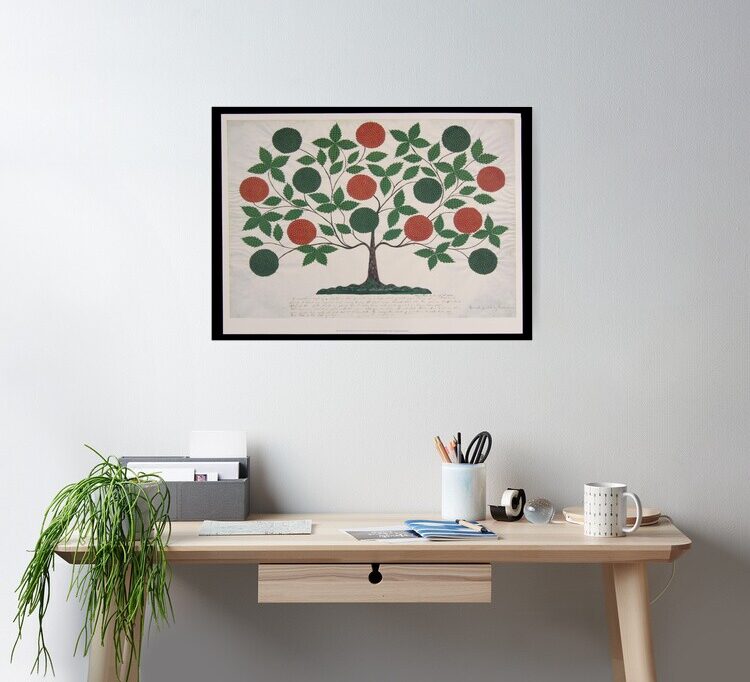
Few Jungian symbols appear as consistently across world cultures as the Tree of Life. In Jung’s framework, the tree is an archetype of the Self — the totality of the psyche, conscious and unconscious alike. Its roots reach into hidden depths; its branches extend toward light and possibility; its trunk represents the enduring core of who we are across time.
Jung himself wrote: “The soul of man is like an ancient tree, whose roots stretch far into the past.”
Shaker Heritage Art renderings of the Tree of Life carry an additional layer of resonance. The Shaker tradition held that craft and community were inseparable from spiritual practice — that making something beautiful was itself an act of meaning. A Shaker-inspired Tree of Life print placed in a workspace or study becomes a daily prompt: What are my roots? What am I reaching toward? What endures in me across change?
Best placement: A home office, creative studio, or therapy room — anywhere you engage in introspective or generative work.
Odd Fellows Symbols: The Archetype of Community and Belonging
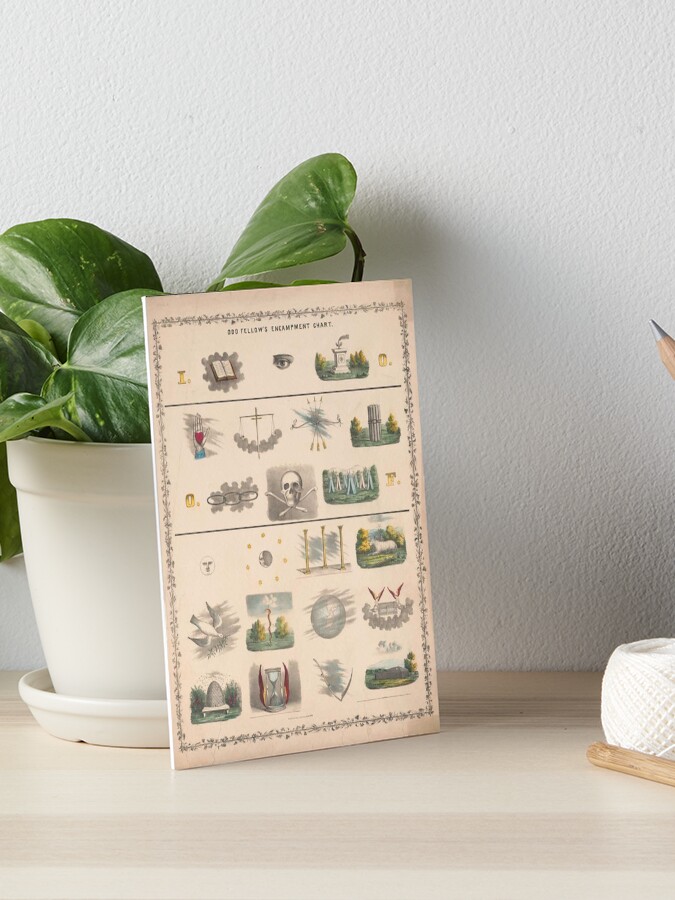
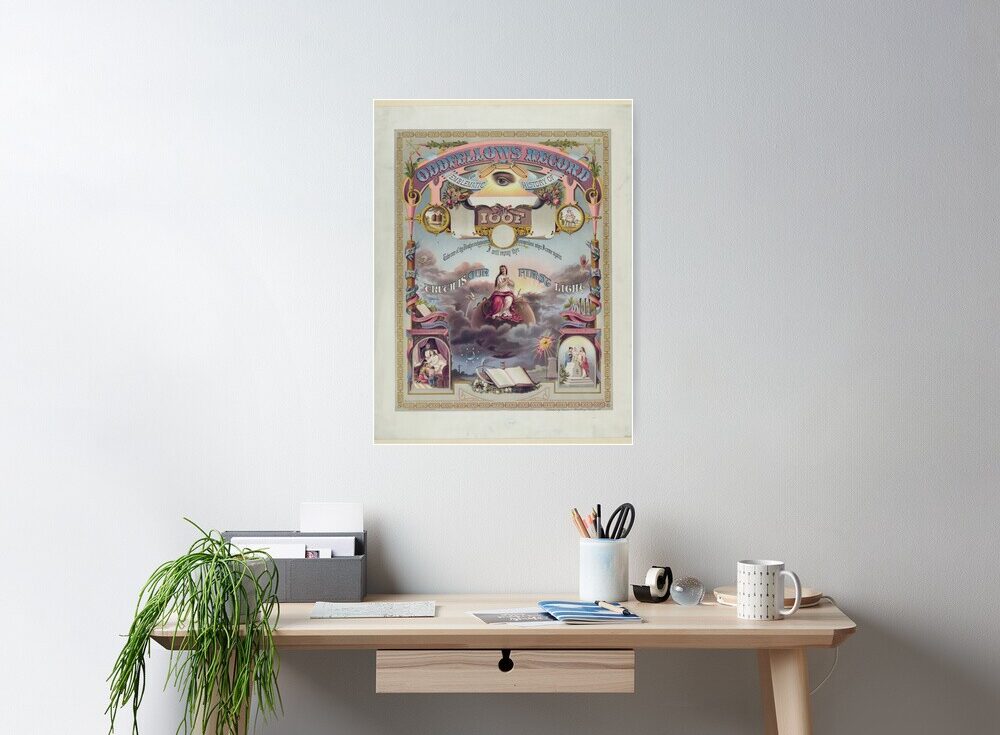
The Independent Order of Odd Fellows was founded on principles that would have resonated deeply with Jung: mutual aid, the acknowledgment of mortality, and the binding of individuals into a community larger than themselves. Their symbols — the Eye of Providence, the three-link chain of Friendship, Love, and Truth, the skull and hourglass as memento mori — draw directly from the archetypal well Jung described as the collective unconscious.
Our 1875 Oddfellows Record Print and Odd Fellows Encampment Chart are not simply historical documents. They are visual maps of what it means to belong — to commit to something beyond oneself, to acknowledge the passage of time, and to find identity within a web of shared obligation and care.
Jung wrote: “We are like islands in the sea, separate on the surface but connected in the deep.” The Oddfellow symbolism makes that invisible connection visible.
Who this resonates with: Anyone navigating questions of community, purpose, or legacy — particularly those doing genealogical research who may have Odd Fellows ancestors.
Celtic Symbols: Spirals, Knotwork, and the Unbroken Thread
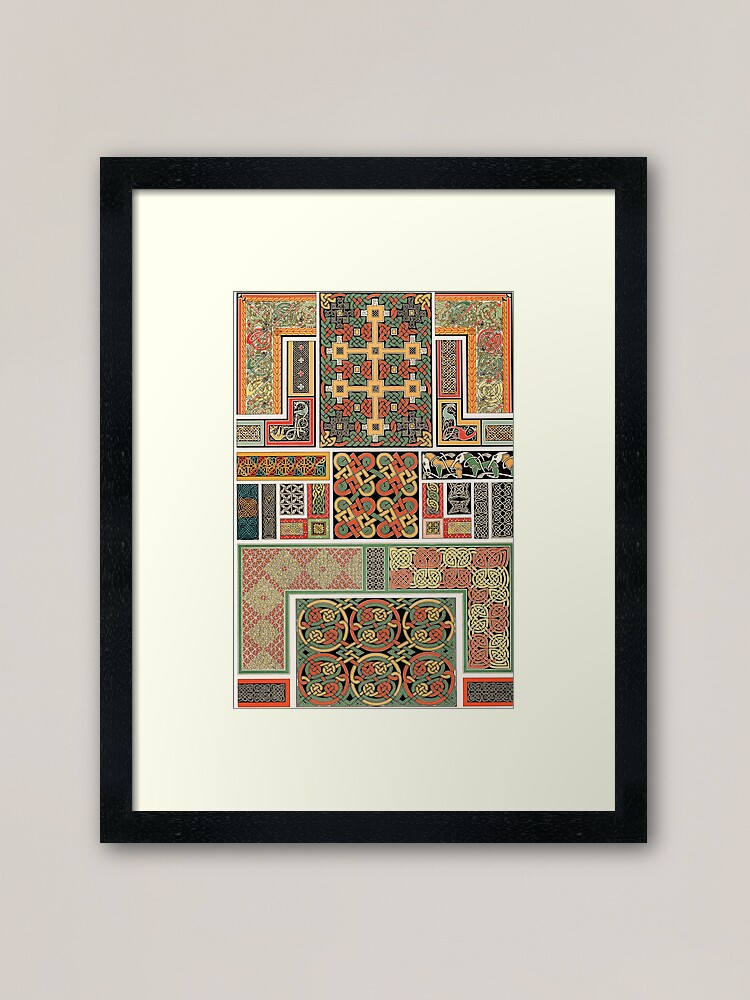
Celtic art is among the most immediately recognizable symbol systems in the Western tradition, and for good reason: it speaks directly to the Jungian archetype of eternity and continuity. The spiral represents the soul’s journey inward and outward. The triquetra evokes the triple nature of existence — past, present, future; birth, life, death; mind, body, spirit. The interlocking knotwork, with no visible beginning or end, is a visual representation of Jung’s own metaphor: “Every individual is an expression of the collective unconscious, which connects him with all mankind and with all the ancestors.”
For those with Celtic ancestry, these symbols function as a direct line to heritage. For anyone drawn to their visual language, they serve as powerful archetypal anchors regardless of lineage. Our framed Celtic symbol reprint of the Celtique detail of the Cologne cathedral from L’ornement Polychrome (1888) by Albert Racinet is an excellent visual anchor for bringing Celtic symbols that affirm the principles of eternity and continuity to your space.
Nordic Runes and Norse Symbols: Symbols of Fate and Self-Determination
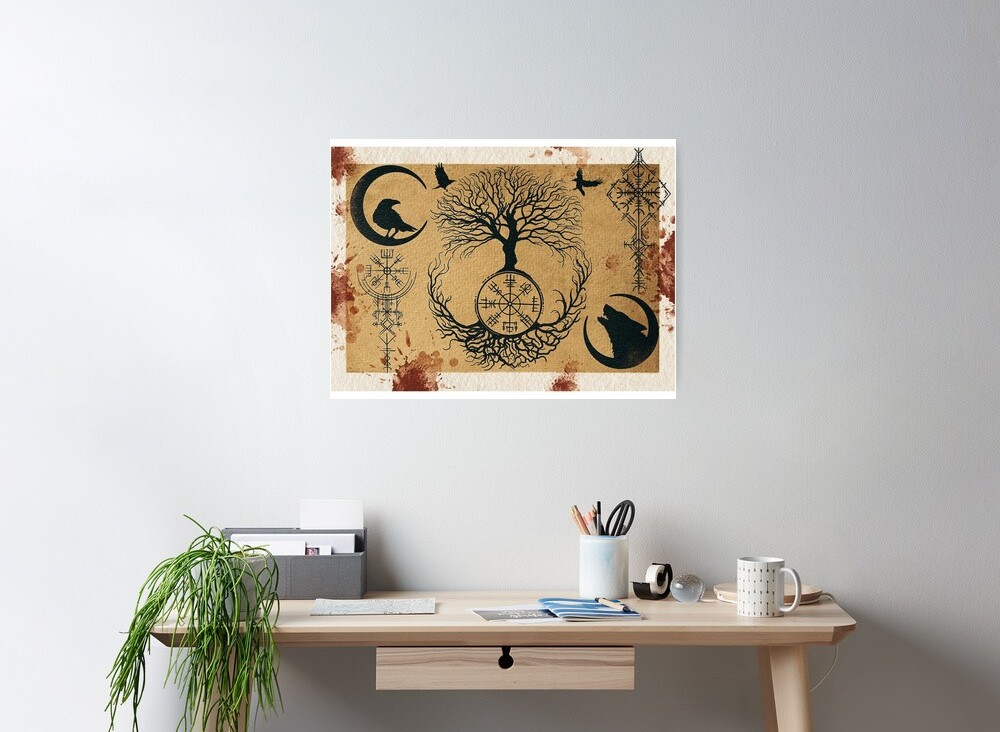
The Norse runic tradition offers a particularly rich set of Jungian symbols for those exploring the tension between fate and free will — a tension Jung addressed directly: “The psychological rule says that when an inner situation is not made conscious, it happens outside as fate.”
Nordic heritage symbols — the Valknut, Yggdrasil (the World Tree), the Vegvísir compass — each carry specific archetypal weight. Yggdrasil, like the Tree of Life, is an axis mundi: the symbolic center that holds all realms together. The Vegvísir, traditionally used to ensure that one does not lose their way, speaks to the Jungian process of individuation itself — the journey toward wholeness through an often uncertain interior landscape.
Nordic prints and heritage art are particularly powerful visual anchors for those who feel called to explore questions of destiny, resilience, and personal direction. Our Yggdrasil – Symbols in Norse Mythology poster is a perfect choice for meditation on these visual anchors.
How to Choose a Jungian Symbol That Resonates With Your Journey
Not every symbol speaks to every person, and Jung would not have had it any other way. The process of discovering which Jungian symbols feel alive for you is itself a form of self-inquiry. Here are a few questions to guide that process:
To identify symbols connected to the Self (your core identity and wholeness), look for circular forms, tree imagery, or mandalas. The Tree of Life in any of its cultural expressions — Celtic, Norse, Shaker, Kabbalistic — belongs to this category.
To identify symbols connected to Community and Belonging, look for fraternal emblems, shared cultural marks, or symbols that carry a sense of covenant — mutual commitment across time. Oddfellows prints and guild symbols speak most directly here.
To identify symbols connected to Ancestry and Lineage, follow the thread of your own heritage. Where did your family come from? What symbols did they live by? Celtic knotwork, Nordic runes, and other cultural emblems become significantly more potent when they carry personal genealogical resonance.
To identify symbols connected to the Shadow (the unacknowledged aspects of the self), Jung pointed toward symbols of transformation — the skull as memento mori, the serpent, fire. Many fraternal traditions incorporated these deliberately, as reminders that growth requires reckoning with what we would rather ignore.
Integrating Jungian Symbols Into Your Space: Practical Guidance
Jung himself worked with symbols in a highly intentional, almost ritualistic way. He carved stone, painted mandalas, and built a tower — Bollingen — where every room held symbolic significance. For most of us, the practice is simpler, but the principle is the same: place symbols where your eyes will find them during the moments that matter.
A heritage print near your desk invites reflection during the mundane hours of work. A Tree of Life in a reading corner creates a context for contemplation. A fraternal emblem in a hallway becomes a daily reminder of the values you’re committed to carrying forward.
The key is intentionality. Choose pieces that connect to a question you are living — not just an aesthetic you admire. Then let the symbol do what Jungian symbols are designed to do: speak quietly and persistently to the parts of you that are still becoming conscious.
Frequently Asked Questions About Jungian Symbols
What is the difference between a Jungian symbol and a regular symbol? All symbols carry meaning, but Jungian symbols specifically connect to archetypes within the collective unconscious — patterns of meaning that are cross-cultural, deeply historical, and psychologically resonant at a level below personal memory. A corporate logo is a symbol; a Tree of Life is a Jungian symbol.
Can Jungian symbols be used even if I’m not in therapy or actively studying Jung? Absolutely. The value of placing a meaningful symbol in your environment does not require formal psychological training. Jung’s ideas are most powerful when lived, not just studied.
Do the symbols need to match my own cultural ancestry? Not necessarily, though personal lineage can deepen the resonance of a symbol significantly. Jung believed that while certain symbols speak most directly to specific cultural lineages, the deeper archetypes belong to all of humanity.
How do heritage prints and artifacts differ from mass-produced décor? Heritage artifacts carry historical weight — they were made within specific communities, for specific purposes, and they encode the values and worldview of those communities. That accumulated meaning is what makes them effective Jungian symbols rather than mere decoration.
Conclusion: Making the Unconscious Visible
Jung believed that we are shaped by forces far larger than our individual lives — by the “psychological heritage” of our ancestors, the universal patterns of the collective unconscious, and the symbols through which all of this becomes expressible. “Who has fully realized,” he asked, “that history is not contained in thick books but lives in our very blood?”
The answer he offered was not passive acceptance of that inheritance, but active engagement with it. The goal of Jungian psychology — the process he called individuation — is to become as conscious as possible of what we carry, so that we can choose, with greater freedom and greater wisdom, what to pass forward.
Heritage artifacts and Jungian symbols, placed intentionally in the spaces where we live and work, are one of the most accessible ways to begin that process. They make the invisible visible. They remind us, daily, of the immense age we carry — and of the responsibility that comes with being, as Jung described it, a living link in an unbroken human chain.
Explore our Heritage Archive to find the symbols that speak to your own story — from Shaker Tree of Life prints and Oddfellows emblems to Celtic knotwork, Nordic symbols, and beyond.
Reflections
Take a moment to reflect: What ancestral patterns might be shaping your life? What “visual anchors” will you use to stay mindful of the influences of the past and the importance of passing that knowledge down?
If you like this quote compilation you may also like these articles:
Self-Discovery Quotes: How Family History and Ancestry Shape Identity
